Showing posts with label disability. Show all posts

18 March 2012

the last 4 months...

for my special peeps. by Luna Soledad
for my special peeps., a photo by Luna Soledad on Flickr.

This is what I've been up to: http://no2nchb916.blogspot.com/

"It was once said that the moral test of Government is how that Government treats those who are in the dawn of life, the children; those who are in the twilight of life, the elderly; and those who are in the shadows of life, the sick, the needy and the handicapped."
...Hubert H. Humphrey

22 January 2012

type 1.

type 1. by Luna Soledad
type 1., a photo by Luna Soledad on Flickr.
At least this one has a name. At least this one has some answers...

While most parents reel with tragic heartache, feelings of guilt and grief, and mourn the sense of normalcy and health for the child they’re suddenly told is no longer just like everyone else, the diagnosis of Type 1 juvenile diabetes was just another drop in the bucket for me... I went through that process long ago. And continue to live in that moment every day, mourning the life my special child could have had, mourning all that she could have been, should have been, had she been born “normal.”

That is not to say that I don’t adore my child in all her quirky, exhausting, pain-in-the-ass glory. That is not to say that I don’t celebrate her milestones, victories, and achievements, albeit delayed. And that is not to say that I do not adore my child and love her more than life; I do. But raising a child with profound special needs is a life-long mourning process - despite the blessings, despite the love... Mourning for a living being is a quiet, secret process that special parents do not dare speak aloud; it conflicts with the emotional programming we work so hard to maintain - that we cherish this precious soul, that there is a reason this angel was born to us, that she is just as deserving of having a good life as anyone else, and that we love her no less...  and we mean it, really we do. But to express grief over someone who we see and touch and love every single day seems hypocritical - and then we feel guilty about that too. So there it is, in all it’s ugliness; our big special secret.

There is not a special parent alive who wouldn’t cut off their right arm to make their child’s life easier... If I knew beyond doubt that my daughter could have the life of a typical 14 year old girl, painting her nails and texting boys and going to slumber parties - I’d saw it off myself with a butter knife.

Diabetes is nothing. Being insulin dependant for the rest of her life is nothing. Finger pricks, carb-counting, and 3-5 injections a day is nothing. I scoff at thee.

A few months back, we noticed that Bell was overcome with an insatiable thirst and peeing like a race horse. Naturally, the doctor wanted to rule out Diabetes... Diabetes? Ha. Are you kidding me? She weighs 60 pounds. She eats well, likes healthy foods, and gets plenty of exercise. Really? Surely, you jest? Turns out however that the doctor was right and I had a lot more to learn about yet another topic I never thought I’d need to know about...

The term “diabetes” is misleading when one considers that over 90% of diabetics in North America and Europe are Type 2 which, despite genetic predisposition, is generally preventable, and can sometimes even be overcome, with a healthy diet and lifestyle. Type 1 however, is an unpreventable autoimmune disease where the body wages war on the pancreatic cells which produce the Insulin needed to disperse sugar to the body’s tissues to burn as fuel. The healthiest person in the world can fall victim to Type 1 and, at present, there’s not a thing anyone can do about it.

It’s not been fun and certainly is not what I envisioned nor hoped for this new year, but Isabel has taken all this medical drama in graceful strides. Better than I ever imagined and most definitely better than I would have! --I firmly believe God instilled in me an irrational fear of needles to prevent me from being a Toredol junkie, not to mention, counting my carbohydrates?!! Cut back on pasta and rice and chocolate? Surely, I would wither and die.

While in the hospital getting Bell stabilized and learning how to do all this pricking and sticking, calculating and charting stuff from the nurses, educators, doctors and their gaggle of interns, I was horrified... and all I could think about was how I have failed miserably at every single fad diet that required even the most elementary of mathematical talents. Dear God, please help me not to kill my child!

Isabel, on the other hand, thoroughly enjoyed the rock-star treatment and being waited on hand and foot. She quickly figured out that a finger stick meant it was time to eat; never one to turn away from food, she was cool with that. And the injections, so long as she’s had her fill, it’s a small price to pay as far as she is concerned. The only rude awakening coming home for her was returning to a routine of doing stuff for herself.

True, I’ve been in survival mode; it’s what us special parents do. And there may be a moment somewhere down the road when I crash, the fog lifts, and I settle in for a brief pity-party (hey, we all do it, even those of us you perceive as invincibly strong), but for now, it is what it is and we’re all still alive... I’m even doing math.

About a week ago, I told Isabel that I was so sorry that this diabetes shit happened to her, that I hated that it was yet one more challenge and thing for her to deal with... I don’t know why this happened, I said to her, maybe mommie still has a few big important lessons to learn in all this... and in one of those rare and magical moments where the window of understanding is cracked just a wee bit and I am able to connect with my wonderful, beautiful, special angel girl, she smiled sweetly at me - the pure, good smile that lives in her soul and once in a great while, makes it out into the world - and signed, “yes.”

So I’m learning, yet again, and I’m grateful that it was just a drop in the bucket; thankful that this one has a name and some answers, because it’s a helluva lot more than I’ve gotten so far from anything Isabel.

Diabetes is nothing.
"We now accept the fact that learning is a lifelong process of keeping abreast of change. And the most pressing task is to teach people how to learn."
...Peter Drucker

29 May 2011

disability etiquette 101.

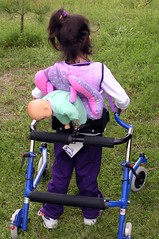
walkin'. by Luna Soledad
walkin'., a photo by Luna Soledad on Flickr.
We’ve all heard it said, “It takes special people to do special things,” and while I tend to agree that not everyone in the world has what it takes to manage certain tasks, journeys, or responsibilities that many see as an impossible misfortune when outside looking into such lives of those who juggle everything life has thrown at them with the illusion of finesse, there are times when folks should just keep their mouths shut and maybe just offer a warm smile instead of some wise-sounding rhetoric... Often, this is a sentiment conveyed by well-meaning strangers when faced with the uncomfortable realization that they are in the presence of a parent, guardian, or care-giver of a person with special needs and feel the need to say something in lieu of, “You poor thing, I feel sorry for you.”

Yes, it’s true, unless you’re part of that inner circle of special populations, exceptional people if you will, (be it family, friend, fellow parent, teacher, therapist, or the like), such expressions, however well-meaning, come across as condescending in a manner not unlike rubbing salt in one’s wounds.

I personally do not need to be reminded of how “special” I am. I live it every day. And I can only imagine that other mothers who spend the bulk of their days having fun with G-tubes, catheters, braces, walkers, communication boards and devices, outrageous behaviors, attending IEP meetings, advocating for the rights of their loved one(s), meeting and communicating with a menagerie of doctors and specialists and teachers and therapists, learning medical shit they never wanted to know about, and wiping ass every single day after day, probably feel the same way. --I assure you, we totally get it.

That being said, I realize that most people don’t intend to be mean or rude (for those who do: go fuck yourselves) and can only act in ways in which their life experiences and / or education afford them. Therefore, I’ve compiled a little list of basic etiquette with regards to encounters with special populations for those nice folks on the outside with honorable intentions:

  • Don’t stare. --I would hope that this is self explanatory, but in case it’s not... staring at people disabled or not is in fact rude. You should teach your children this too, however, as a general rule, it’s not a child’s natural curiosity that bugs me so much as their parents... encourage your child to instead say hello, smile, or wave. And if they are curious about a wheelchair or such, allow them to ask; if they ask you within earshot, don’t drag them off, shush, or punish them... it’s how they learn that people with disabilities are indeed people too and everyone benefits from kindness.

  • Don’t ignore. --Many people feel uncomfortable when faced with a situation outside of their experience, even if that situation is meeting a person with a disability. Perfectly natural. But no one likes to be ignored. If my daughter waves at you, as she is prone to do, would it kill you to smile and wave back? She’s not asking for a loan or even a dinner invitation, just acknowledgment.

  • Never assume anything. --People are like fingerprints: each are special and unique. Disabilities are like fingerprints: each are special and unique. Just because a someone may have the characteristic appearances of someone with Downs Syndrome doesn’t mean the individual in front of you functions at the same level as that actor you saw in a TV show once (like actor Chris Burke). Just like regular people (not everyone is a PhD and not everyone can cook edible food), there is an enormous spectrum of varying abilities. In fact, people are most familiar with the term “spectrum” thanks to the public awareness of Autism; the autistic spectrum is a perfect example of extremes. There are persons with Autism who may be a bit quirky (who isn't?) but are amazingly gifted, highly intelligent productive members of society and there are those who cannot speak and live trapped in the darkness of their own worlds unable to dress themselves... even more rare and amazing are minds such as Kim Peek. Just like Autism, disabilities can be every bit as much of an enigmatic intellectual span. This includes issues such as ADD, ADHD, ODD, OCD, and a whole host of other fun stuff, all of which are real, legitimate, and can sometimes be just as debilitating.

  • But they look "normal". --See above.

  • If you feel inclined to speak, direct your conversation first at the person of interest before addressing the parent or caregiver. --It’s just common courtesy and though it’s not the case with my child, most people with disabilities, even intellectual ones, can speak and carry on a basic, albeit probably unconventional, conversation. And they appreciate the attention and exchange because unfortunately they are used to being ignored. It also makes Mom feel good because someone was thoughtful enough to make their kid’s day. Just don’t be disappointed or take it personally if the special person doesn’t outwardly acknowledge you back in a manner in which you are accustomed. Trust me, they noticed; they just may not be able to unlock what they need to access in order to show it.

  • Never underestimate. --I have had to learn this one myself, over and over again, with my own daughter and to this day, she continues to make a liar out of me (as well as many specialists!) should it dare be stated that she is unable to do something. Even for persons closest to an exceptional individual, who know their language, abilities, and behaviors best, it is impossible to know what is understood, unable, or merely defiance.

  • If you feel inclined to inquire, choose your words carefully. --For instance, rather than asking, “What’s wrong with her?” try instead, “What’s her diagnosis?” As a general rule of thumb, stop and think how you would feel if some random stranger walked up and said this to you about your child. Again, children are an exception... A child can only communicate with what vocabulary and communication skills they have acquired in their short little life-spans. When a child asks me why my daughter doesn’t speak or what’s wrong with her, I will happily stop whatever mad errand I am in the middle of, drop to a knee and explain as best I know how with all the patience of Saint Monica because that’s how they learn to become better world citizens. But as a perfectly functioning allegedly competent adult, if you ask me such an asinine question as “What’s wrong with her?” you can expect an equally rude and ridiculous response, such as, “Absolutely nothing; what’s wrong with you?”

  • Ask for help. --Most parents and caregivers don’t mind at all if you ask questions that help you to include their child and loved one. Perhaps they are deaf or do not speak and use sign language... I love when people ask me how to sign something to my daughter (though she can hear perfectly well I’m told; selective listening is another matter entirely) or if she needs assistance with a task... This shows you care.

Someone once told me that disability is not an "if" but a "when." Meaning, there will come a time in each of our lives when we are not capable of being independent to some degree, be it a broken bone, illness, old age, or dementia and will require the care and assistance of others in order to have our needs met... Think about that.

When all else fails, there is always The Golden Rule. Remember that one folks? It goes like this: “Do unto others as you would have done to you.” And by the way, that’s a good one to teach your kids too!

A public service announcement brought you to by yours truly...

"Special people were not born upon this earth to be tested, rather to serve as a litmus for humanity."

...Crystal J. De la Cruz, mother & advocate
16 March 2010

without handlebars.


Weee!, originally uploaded by Luna Soledad.

Raising a child with special needs is sometimes like riding a bicycle without handle bars. You know where you’re supposed to go and no idea how to get there. You will fall and you will get back up and go again because you have to. And you will get tired of the journey, of going around in circles, of the monotony of your days… You get tired of hurting, of hoping, or wishing, and the fear of the unknown. But you keep going.

There are times when you find yourself angry and asking, “Why me?” while other bikers pass swiftly by you, carefree and oblivious. Often they smile out of kindness, or pity; others may even stare and ask what is wrong with your bike? Still others might just pretend you aren’t there, afraid to look. You learn to deal with it and keep going.

Some days you’re just tired of being tired. You have to get off and walk the bike. There are even times when you have to kick out the kick stand and park it so you can find time to cry. But you keep going.

And just when you feel like you can’t go any further… something magical will undoubtedly happen – a milestone. Although delayed and awkward and clumsy, it happens and suddenly you know joy and pride that no typical run-of-the-mill biker could ever know. And that makes the journey all worthwhile…

Like a sudden burst of energy, you will find your strength… and do it all over again.

© Crystal J. De la Cruz, 18 June 2009
Raleigh, North Carolina


"Congress acknowledged that society's accumulated myths and fears about disability and disease are as handicapping as are the physical limitations that flow from actual impairment."

...Justice William J. Brennan, Jr.